Anyway, Rama's comments about craft set me thinking. 'But craft requires mastery of technique along with creativity, making it a tougher field'.
(Rama Gopinath lives near Seattle and Gopi takes me golfing at his club on our visits to our daughter Nandini .)
To reminisce, it took me back to the time, years ago in Khajuraho, when I saw both Tara and Raji suddenly run excitedly towards..... well a hand cart full of brass figurines. These were all very well crafted and very beautiful and are still displayed in our living room.
They paid whatever the vendor quoted as a price. Anyway there was no way he would have reduced prices after he saw them grabbing at the idols with such a happy smile. Later I saw a foriegn tourist bargaining hard and reducing the prices by 40 percent. I did not grudge the extra money, though we then lived on what is called a balanced budget.
It is preferred that people, when travelling, buy local handicrafts and thus encourage the artisans and craftsmen of the place visited. It does not matter that these may get boxed once the novelty of the item is gone. It is a way of helping the needy of that area. We are all aware that this business of 'Art and craft' is very big. Indeed in India, each state has a 'Government Emporium' of handicrafts located in Delhi. The range is amazing in its variety. While we hope that the money we spend does get to the real people involved in the creation of Handicrafts, I know for certain that this does happen in the organisation I am writing about.
I am happy to have written in my earlier blogs about people I know, Viji is an art lover turned curator and Varsha, an artist who loves to take us through the process. Both give back to the society in their own distinct ways. So it is with pleasure and great pride I talk about Raji, and specially about her association as a designer with 'Dwaraka' in Bangalore. Anyway it was in Pune we met Raji, in fact she was still a bride when Lakshmi Narayan and Raji moved to the apartment opposite to ours and we have truly adopted each other's families. It was clear even then that Raji had an eye for beauty. She designed and made very pretty 'girls' clothes and held exhibitions and was generally 'sold out'.
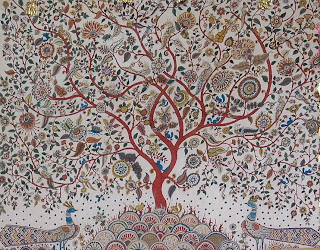
 Well, Dwaraka is an acronym for 'Development of Weavers and Rural Artisans in Kalamkari Art'. It is a neat one. It is a non-profit charitable trust and Raji volunteers her time. I was in Bangalore when the Dwaraka showroom was inaugurated in the year 2001 and was fortunate to hear the founder trustee Mr. Dwaraknath Reddy speak. His humanity was apparent as he spoke. He is well known, is the Chairman of the Nutrine Group of Companies. His daughter Anita Reddy, a trustee, is a very dedicated social worker. The inspiring story of DWARAKA is well documented in http://www.dwarakaonline.com/ and going through it will enable you to learn more about Kalamkari art as well.
I left for Bangkok soon after that. I thought Raji had given an excellent welcome speech and had handled the organisation of the show very well. In fact, the first time I heard her giving a speech in public! While I was not cynical, I knew that Raji was not a typical socialite, the set up appeared very conventional and could have been just a past-time. Here was an organisation, founded by an industrialist, run by his daughter (who was also the daughter-in -law of Late Mr. K.C. Reddy, The first chief minister of Mysore state) and Raji (wife of Jt. M.D of MICO BOSCH). She could well have chosen to use her time to be part of the elite groups in Bangalore. Anyway, I thought it was a fine way to spend a little time doing good and would be beneficial for her as well.
The story turned out be very different. Whenever I visited Bangalore, I realised it was not that easy to meet Raji. She would be either in Dwaraka or visiting Kalahasti in Andhra Pradesh interacting with the artisans. We all know the mythical story of Gopis dropping everything they were doing when they heard the flute of Krishna in the ancient 'Dwaraka'. I used to kid Raji that the pull of 'this' Dwaraka seemed as strong if not stronger for her.
The story turned out be very different. Whenever I visited Bangalore, I realised it was not that easy to meet Raji. She would be either in Dwaraka or visiting Kalahasti in Andhra Pradesh interacting with the artisans. We all know the mythical story of Gopis dropping everything they were doing when they heard the flute of Krishna in the ancient 'Dwaraka'. I used to kid Raji that the pull of 'this' Dwaraka seemed as strong if not stronger for her.
She would invariably say, not as an apology for being too busy, but as an explanation that all these people depended on her. It is something she had to do and being what she is, had to do it well, very well and extremely well. Her commitment is truly phenomenal.
We are all very happy and proud of the growth and success she has achieved in developing products for Dwaraka. It is sold well in India and is exported as well. In a recent exhibition in London she and Dwaraka were requested to participate and did attract a lot of attention.

(Raji at the Regent street festival, Indian Summer in London. )
It is providential that Raji and Anita Reddy met when Raji's daughter Meghana took to serious swimming. (Meghana represented India at the Asian Games in Bangkok). This meeting resulted eventually in Anita Reddy inviting Raji to take charge of Dwaraka. Since then the organisation has grown and today has a turnover of about 8 Million Rupees and is able to support about 350 families in and around Kalahasti.
Most importantly the artisan families are no more required to wander in the big cities hawking their produce like they used to do earlier. This is what they said when they met the Reddy family some years ago, “We come to big cities and go door to door trying to sell our art, but more often than not, we are mistaken for beggars and driven away.” What has transpired since then is the story of Dwaraka!
The trustees of Dwaraka have very nicely said: 'For Raji, as she herself often says, her visits to Srikalahasthi stimulate her into greater service, and to the artists who eagerly wait for her with deep respect and affection it is a joy to work with their “Raji Amma”

Raji, is one of those rare people who chose to commit her time and energy voluntarily towards the upliftment of the poor, while she could have chosen to have sat back and enjoyed the leisurely comforts within four walls. She humbles one by her sincerity and dedication and the Ramanarpanam Trust acknowledges her selfless service'.
And also quote from one the articles I found on the web here: http://www.boloji.com/wfs5/wfs983.htm
Three Cheers for Artisans by Fehmida Zakeer
The girls in the kalamkari unit in Andhra Pradesh were encouraged to form groups and open bank accounts. A Community Development Fund was also instituted for the 150 women artisans. Designer Raji Narayan joined hands with Reddy to initiate design awareness among the girls. "This helped them approach their work with an artistic temperament and increased the value of their products." Now, they make saris, dress materials, cushion covers, handbags, and even greeting cards that are sold at an exclusive Dwarka boutique in Bangalore. Almost all girls have managed to bring their families out of the vicious debt cycle. Reddy gives the example of young Kanchana. "She has managed to pay off her father's debts, educate her brother and marry off her sister." She adds, "The confidence level among the girls has increased. They now share thoughts and problems, often extending a helping hand to each other." )
Webistes featuring Dwaraka and its products:
http://www.hindu.com/thehindu/mp/2006/08/21/stories/2006082101750300.htm
I thought I would include this treasure I found in the world wide web or should we say w.w.wonder. You can see an enlarged picture by clicking on it.
I thought I would include this treasure I found in the world wide web or should we say w.w.wonder. You can see an enlarged picture by clicking on it.
 Kalamkari wall hanging, ca. 1640–50; MughalIndia, Madras region, perhaps PulicatCotton, resist dyed and painted; L. 99 1/2 in. (252.73 cm), W. 77 in. (195.58 cm)Gift of Mrs. Albert Blum, 1920 (20.79)
This wall hanging, called a kalamkari after the technique for producing it, is made of woven cotton patterned by a pen with mordants and resist mediums. The famous process could take months to complete because it required numerous laborious procedures before the final design was accomplished. The scenes in this example may represent unrelated episodes played out in different areas of a princely edifice and its garden. An elegant couple with a small naked child dominate the spectacle. A still life of vases and bottles separates them from three ladies dressed in beautifully patterned saris who seem to be hurrying to a rendezvous. Figures sit or stand on balconies, archways, and pavilions, mostly dressed in Indo-Persian or Indian garments. Two Europeans, perhaps representing traders living in the area, add an exotic touch. Below, a courtly reception unfolds in a landscape with musicians, servants, guests, and even cats and other animals in attendance upon the nobles. Above, a row of standard-bearers, princely figures, and an ox cart march in procession toward an unseen goal.

Citation for this page:
"Kalamkari wall hanging [India, Madras region] (20.79)". In Timeline of Art History. New York: The Metropolitan Museum of Art, 2000–http://www.metmuseum.org/toah/hd/intx/hod_20.79.htm (October 2006)
"Kalamkari wall hanging [India, Madras region] (20.79)". In Timeline of Art History. New York: The Metropolitan Museum of Art, 2000–http://www.metmuseum.org/toah/hd/intx/hod_20.79.htm (October 2006)
I hope the Met does not mind me copying this for my blog.


